
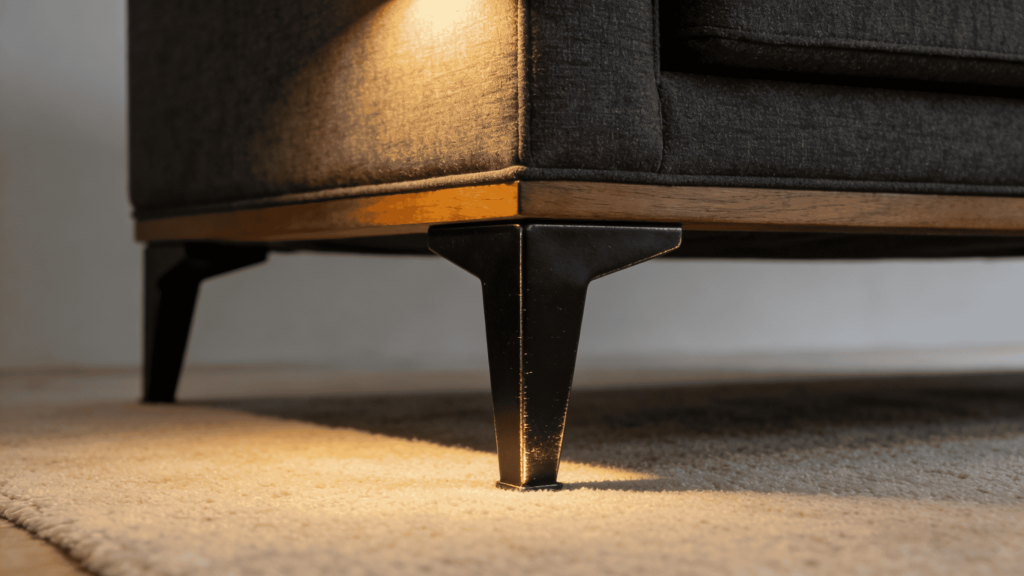
Understanding furniture leg load capacity is crucial for ensuring safety, durability, and compliance with international standards. This comprehensive guide examines load testing methodologies, weight distribution principles, and regulatory requirements that govern furniture leg performance across residential, commercial, and specialized applications.
Fundamentals of Load Capacity Engineering
Weight Distribution Principles
Furniture legs must support not only static weights but also dynamic loads from movement and use. The ISO 7173 standard specifies that furniture legs should withstand forces significantly higher than typical use conditions to account for safety margins. A properly designed four-leg system distributes weight evenly, while three-leg configurations require precise engineering to prevent tipping.
Load distribution follows the formula: Point Load = Total Weight ÷ Number of Legs × Safety Factor. Industry standards typically recommend a safety factor of 1.5-2.0 for residential furniture and 2.5-3.0 for commercial applications. This accounts for uneven weight distribution, dynamic loading, and long-term material fatigue.
Critical Load Capacity Metrics
| Load Type | Definition | Testing Standard | Typical Requirement |
|---|---|---|---|
| Static Load | Constant weight applied indefinitely | BIFMA X5.9 | 150% of rated capacity for 7 days |
| Dynamic Load | Repeated loading/unloading cycles | ISO 7173 | 100,000 cycles at 125% load |
| Impact Load | Sudden force application | ANSI/BIFMA X5.1 | 200% load dropped from 6 inches |
International Testing Standards Overview
BIFMA Standards for Commercial Furniture
The Business and Institutional Furniture Manufacturers Association (BIFMA) sets comprehensive testing protocols for office and commercial furniture. Key standards include:
- BIFMA X5.1: General purpose office chairs – requires 250-pound cyclic testing
- BIFMA X5.5: Desk tests – verifies stability under 225-pound loads
- BIFMA X6.1: Educational seating – addresses abuse resistance requirements
BIFMA testing typically involves applying loads to furniture legs at various angles and measuring deformation, with maximum allowable deflection typically limited to 2-3% of leg length.
European EN Standards
European standards provide alternative testing methodologies with specific regional requirements:
- EN 12520: Domestic seating strength and durability
- EN 1335: Office chair requirements
- EN 1728: Domestic seating test methods
European standards often emphasize long-term fatigue testing, with requirements extending to 200,000 cycles for high-use commercial applications.
Material-Specific Load Capacities
Metal Leg Performance Characteristics
Metal furniture legs offer superior strength-to-weight ratios, with capacities varying by material and design:
| Material | Tensile Strength | Typical Load Capacity | Applications |
|---|---|---|---|
| 6061 Aluminum | 35,000 PSI | 300-500 lbs/leg | Residential, light commercial |
| 304 Stainless Steel | 85,000 PSI | 600-1,000 lbs/leg | Commercial, healthcare |
| Carbon Steel | 70,000 PSI | 500-800 lbs/leg | Industrial, heavy-duty |
Wooden Leg Strength Considerations
Solid wood legs provide excellent compressive strength but require careful engineering for optimal performance:
- Oak: 6,000-7,000 PSI crushing strength
- Maple: 7,000-8,000 PSI crushing strength
- Walnut: 5,000-6,000 PSI crushing strength
Wood legs performance heavily depends on grain orientation, with vertical grain configurations providing up to 30% greater strength than flat-sawn orientations.
Testing Methodologies and Equipment
Static Load Testing Procedures
Static testing involves applying constant loads to furniture legs using calibrated weights or hydraulic systems. According to ASTM D143 standards, tests should maintain loads for minimum 24-hour periods while monitoring deformation. Critical measurements include:
- Initial deformation under load
- Permanent set after load removal
- Recovery percentage
Dynamic Fatigue Testing
Fatigue testing simulates years of use through repeated loading cycles. Standard protocols involve:
- Cycle Frequency: 10-30 cycles per minute
- Load Magnitude: 125-150% of rated capacity
- Test Duration: 100,000-200,000 cycles
Testing equipment must meet ISO 7619 requirements for accuracy and calibration to ensure consistent results across testing facilities.
Application-Specific Load Requirements
Residential Furniture Standards
Residential furniture legs must balance aesthetics with practical safety requirements. While formal standards are less stringent than commercial specifications, reputable manufacturers typically adhere to these minimum residential guidelines:
| Furniture Type | Minimum Load/leg | Safety Factor | Testing Standard |
|---|---|---|---|
| Dining Chairs | 250 lbs | 2.0x | ANSI/BIFMA X5.1 |
| Dining Tables | 300 lbs | 1.5x | BIFMA X5.5 |
| Sofas | 200 lbs | 2.0x | EN 12520 |
| Bookshelves | 400 lbs | 1.5x | ASTM D7031 |
These requirements account for dynamic loading scenarios like sitting down quickly or children climbing on furniture, which can generate impact forces 3-4 times body weight.
Commercial and Institutional Requirements
Commercial applications demand significantly higher durability and safety margins. The ASTM E3090 standard specifies rigorous testing for public space furniture:
- Office Furniture: 125,000 cycles at 300 lbs per leg
- Educational Furniture: Impact resistance to 250 ft-lbs
- Healthcare Furniture: Chemical resistance plus 500 lbs static load
- Hospitality Furniture: 200,000 cycles with 400 lbs dynamic loading
Commercial standards also address accessibility requirements, ensuring stability for users with mobility aids and varying weights.
Custom Engineering Solutions
Heavy-Duty Applications
Specialized applications require custom engineering approaches that exceed standard requirements:
- Industrial Workbenches: 1,000-2,000 lbs per leg capacity
- Laboratory Equipment: Vibration damping plus 800 lbs capacity
- Server Racks: 1,500 lbs with seismic resistance
- Medical Imaging: 2,000+ lbs with precision leveling
These applications often require custom engineering solutions involving finite element analysis (FEA) and material testing to verify performance under extreme conditions.
Structural Analysis Techniques
Advanced engineering methods ensure optimal leg performance:
- Finite Element Analysis (FEA): Computer simulation of stress distribution
- Modal Analysis: Vibration and resonance testing
- Fatigue Life Prediction: Estimating service life under cyclic loading
- Buckling Analysis: Preventing structural failure under compression
These analytical techniques enable engineers to optimize material usage while ensuring safety margins meet or exceed regulatory requirements.
Compliance and Certification
Third-Party Certification Programs
Independent verification ensures compliance with published standards:
| Certification | Scope | Testing Requirements | Validity Period |
|---|---|---|---|
| BIFMA LEVEL® | Sustainability & performance | Comprehensive testing suite | 2 years |
| GREENGUARD | Emissions & chemical safety | VOC emissions testing | 1 year |
| UL Environment | Environmental claims | Life cycle assessment | 3 years |
Documentation and Traceability
Proper documentation ensures compliance throughout the product lifecycle:
- Test Reports: Detailed records of all verification testing
- Material Certifications: Verification of material properties
- Production Records: Batch tracking and quality control data
- Installation Guidelines: Proper installation procedures
Future Trends in Load Testing
Advanced Materials Testing
Emerging technologies are revolutionizing load capacity verification:
- Smart Sensors: Real-time load monitoring during use
- Predictive Analytics: AI-driven failure prediction
- Advanced Composites: Higher strength-to-weight ratios
- 3D Printed Testing: Rapid prototyping and validation
Sustainability Integration
Future standards will increasingly address environmental factors:
- Life Cycle Assessment: Environmental impact evaluation
- Circular Economy: Recyclability and reuse potential
- Carbon Footprint: Emissions tracking and reduction
- Sustainable Materials: Renewable and recycled content
Practical Selection Guidelines
Choosing the Right Load Capacity
Follow this systematic approach to ensure proper leg selection:
- Calculate Total Load: Include furniture weight plus maximum expected use load
- Determine Safety Factor: Apply appropriate margin for your application
- Consider Dynamic Loading: Account for movement and impact forces
- Verify Compliance: Ensure relevant standards are met
- Plan for Maintenance: Include inspection and replacement schedules
Common Pitfalls to Avoid
Avoid these frequent mistakes in load capacity planning:
- Underestimating dynamic load forces
- Ignoring uneven weight distribution
- Overlooking long-term material fatigue
- Neglecting installation quality
- Forgetting about floor protection requirements
Explore our heavy-duty furniture leg collection for commercial applications, or consult our custom engineering services for specialized requirements.